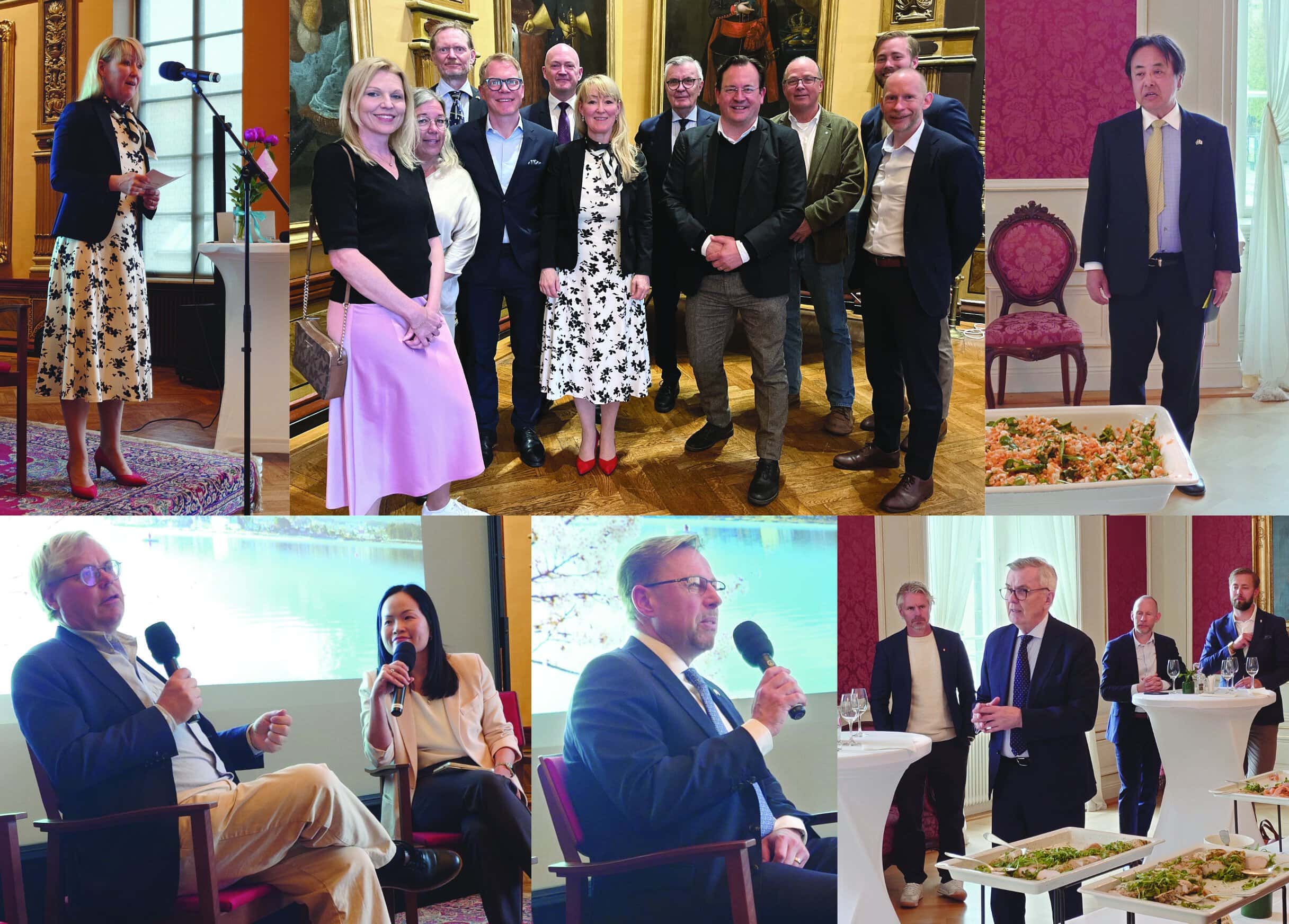
Japan Bridge Scandinavia continues to focus its efforts as a catalyst for companies, startup and innovation environments, municipalities and universities to be open to opportunities in Japan and conversely for actors in Japan to consider the Nordic region as Europe’s Silicon Valley. On 11 May 2026, we celebrated our 5th anniversary together with honored guests at the Malmö City Hall. The afternoon started off with interviews conducted by Sarah Lidé from Medicon Village with both Martin Gren, co-founder of Axis Communications, and Nicolas Hassbjer, founder of HMS Networks and Honorary Consul-General for Japan in southern Sweden. It was clear from both conversations that these successful Japanese-Swedish collaborations, are founded on long-term commitment and the building of mutual trust. The advice for new businesses and entrepreneurs is to spend time to understand the culture and to draw on best practise from each country.
We also listened to one of the founders of Japan Bridge Scandinavia, Anders Olshov, who shared with us the thoughts and ideas that led
to the formation of the organisation, and to former Swedish Ambassador in Japan, Lars Vargö sharing interesting and humorous encounters during his time in Japan.
During the afternoon the Annual Meeting was held where a new board was elected, and we are very pleased to welcome old and new members of the board; Ofelia Madsen, Mikael Palmquist, Anders Olshov, Lars Vargö, Johan Grundström Eriksson, Petter Magnusson Hartman, Monika Liljenqvist Hermansson, Caroline Wigren-Kristoferson, Viktor Öwall, Adam Sandgren, Micael Nord and Henrik Fajerson. Finally our heartfelt thanks to His Excellency Hideaki Mizukoshi, Ambassador of Japan to Sweden.
Japan Bridge Scandinavia is a member-based organization, and our warm thanks to all our members making this possible. Our goal of establishing a significant Japanese hub in the Nordic region remains. If you wish to be part of our journey please get in touch!

Intelligence Watch, a Swedish think tank, has written the new report “Scandinavia’s Sustainable Tech Banana Beckons Japan” about the existing business, research and political relations between Japan and Scandinavia. It recommends Japan to collaborate more with Europe’s more sustainable version of California’s Silicon Valley, which in the report is called Scandinavia’s Sustainable Tech Banana due […]
J-PARC (Japan Proton Accelerator Research Complex) became the second high-power neutron spallation source in the world in 2008. ESS (European Spallation Source) in Lund, Sweden, is the third. The two facilities exchange technical information and experiences since 2012. In 2017 the Memorandum of Collaboration was renewed in front of Prime Ministers Abe and Löfven and again in 2022 by director Schober, ESS, and director Kobayashi, J-PARC.
Could dads with strollers become a boon to socioeconomic success, innovation and productivity growth, and even help slow Japan’s population decline? In an op-ed in The Japan Times, Anders Olshov, Noboru Konno and Jesper Edman suggest they might. Japan should look to Sweden to understand how the Nordic country is tackling comparable social and economic challenges. Interviews with dads walking strollers are highly recommended, they write.
The Japan-EU Economic Partnership Agreement (EPA) entered into force on 1 February 2019, opening a new marketplace home to 635 million inhabitants and almost a third of the world’s GDP. Together with the EU-Japan Strategic Partnership and the EU-Japan Green Alliance
t brings the people of Japan and Europe closer than ever before.






By joining Japan Bridge Scandinavia, your organisation will have the opportunity to be part of the process of building deeper relations between Japan and Scandinavia and interact with stakeholders, experts and policymakers in a variety of settings
On 10 November 2019, the Swedish think tank Intelligence Watch highlighted the strong business and research ties between Malmö-Lund in Southern Sweden and Japan. Companies like Axis (a Canon subsidiary) and Sony employ 3,000 people there, while 70% of the cars in the local harbor are Japanese.
Other collaborations include J-PARC and ESS in high-power neutron spallation, and Nippon Foundation’s major funding of the World Maritime University. Moreover, several Japanese firms have their Nordic headquarters in the region, and companies such as Alfa Laval and Tetra Pak consider Japan a key market. In September 2020, a significant meeting led to the agreement to establish Japan House Scandinavia in Malmö.